


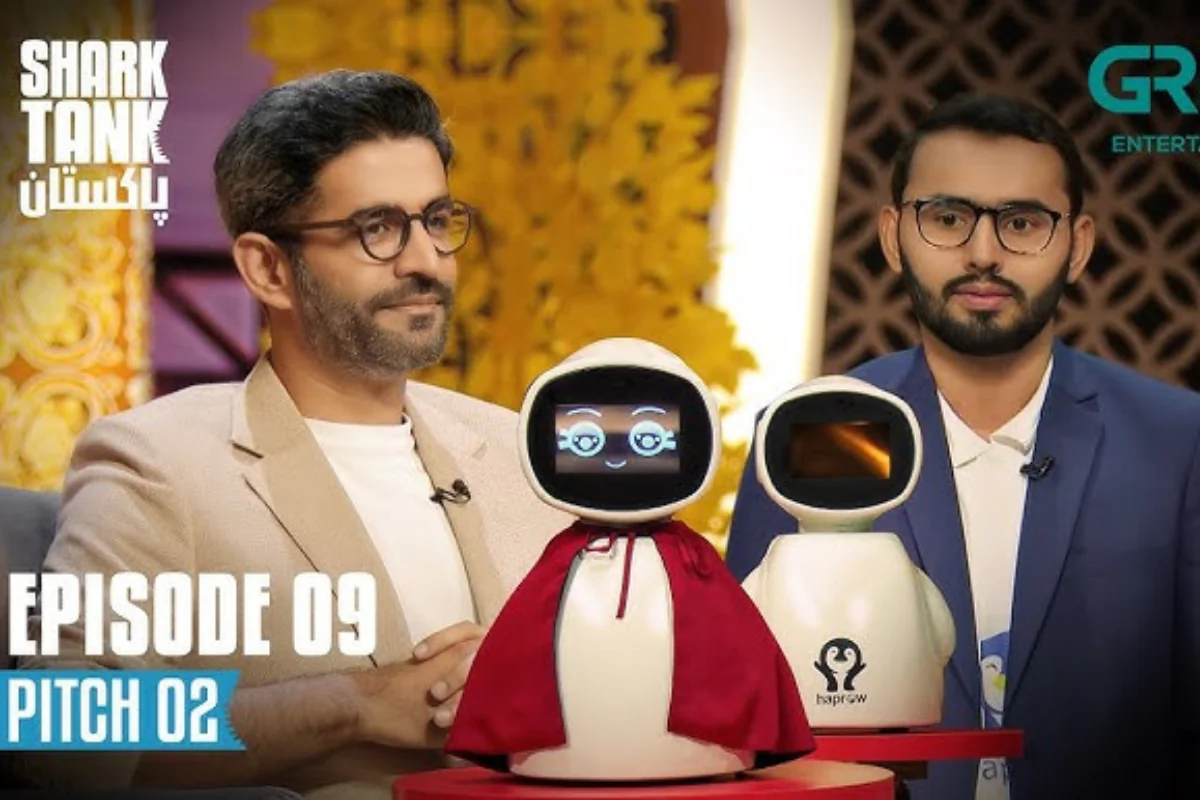
When Muhammad Ali Abbas – Founder & CEO walked into the tank, he wasn’t just pitching a product, he was presenting a lifeline. On a recent episode of Shark Tank Pakistan, the founders of Haprow showcased TimTim, an AI-powered companion robot that marks a historic milestone in Pakistani robotics.
The pitch was one of the most emotionally charged and technically impressive segments of the season, sparking a fierce bidding war among the “Sharks” and highlighting the immense potential of Pakistan’s HealthTech sector.
The Pitch: 1.8 Crore for 5% Equity
Ali entered the tank with a bold valuation, seeking PKR 1.8 Crore for 5% equity in Haprow. Their presentation was centered on TimTim, a small, circular robot designed with a specific mission: to assist children with Autism Spectrum Disorder (ASD) and other special needs.
What Makes TimTim Unique?
The founder demonstrated how TimTim transcends the capabilities of a standard educational toy. The robot utilizes proprietary AI to:
-
Detect Movement: Use sensors to track the physical gestures and reactions of special needs children.
-
Therapeutic Language: Incorporate the specific vocabulary and methods used by professional speech and occupational therapists.
-
Social Engagement: Provide a non-judgmental, consistent companion that helps children bridge the gap to human social interaction.
As Muhammad Ali Abbas explained to the Sharks, the design—compact and circular—was intentional, aimed at being approachable rather than intimidating for children who experience sensory sensitivities.
Inside the Tank: The Sharks’ Reaction
The Sharks—including Usman Bashir, Faisal Aftab, Junaid Iqbal, Aleena Nadeem, and Rabeel Warraich—were initially struck by the social impact of the business. However, as the pitch progressed into the financials and global scalability, the conversation shifted from philanthropy to high-stakes venture capital.
The Debate Over Manufacturing and Sourcing
A key point of discussion was the supply chain. The founders were transparent about sourcing components from China while focusing the core “intellectual property” and AI development in Karachi. This sparked a debate among the Sharks regarding:
-
Cost Efficiency: How Haprow plans to reduce the price point to make it accessible to middle-class Pakistani families.
-
Global Export: The potential for TimTim to disrupt the international market, where similar robots like Milo or Buddy cost thousands of dollars.
“This is not just a business; it’s a mission. The world needs TimTim, and Pakistan needs to be the one to give it to them.” — Shark Perspective during the pitch.
Why Haprow is a Gamechanger for Pakistan
Haprow’s Shark Tank appearance was more than just a fundraising exercise; it was a demonstration of Product-Led Growth. In an ecosystem often dominated by service-based IT companies, Haprow stands out by owning the entire stack: from hardware design to the AI algorithms.
Key Takeaways from the Appearance:
| Highlight | Detail |
| Social Innovation | Addressing the 1 in 68 children globally affected by autism. |
| IP Ownership | Demonstrating that Pakistani engineers can build high-end autonomous hardware. |
| Market Potential | Tapping into the global EdTech and HealthTech sectors, valued at billions. |
| Investor Validation | Proving that “impact investing” can yield high financial returns. |
The Outcome and the Future
While the negotiations in the tank were intense, the exposure from Shark Tank Pakistan has already catalyzed Haprow’s growth. Following the episode, the company saw a surge in inquiries from both local NGOs and international distributors.
The “TimTim” pitch has become a landmark moment for the show, proving that Pakistan is capable of producing deep-tech solutions that serve a global purpose. Whether it’s through the mentorship of the Sharks or the massive public interest generated, Haprow is now positioned to move from a startup to a global leader in assistive robotics.
What’s Next for Haprow?
Post-Shark Tank, the team is focusing on:
-
Mass Production: Finalizing their industrial-scale manufacturing lines to lower consumer costs.
-
Multilingual AI: Developing TimTim to support Urdu and other regional languages to better serve the local population.
-
Clinical Trials: Partnering with leading hospitals to validate TimTim’s therapeutic outcomes.
Haprow’s journey from a Karachi workshop to the bright lights of Shark Tank is just the beginning. As TimTim starts reaching homes across the country, the message is clear: the future of Pakistani innovation is here, it is intelligent, and it is incredibly empathetic.