


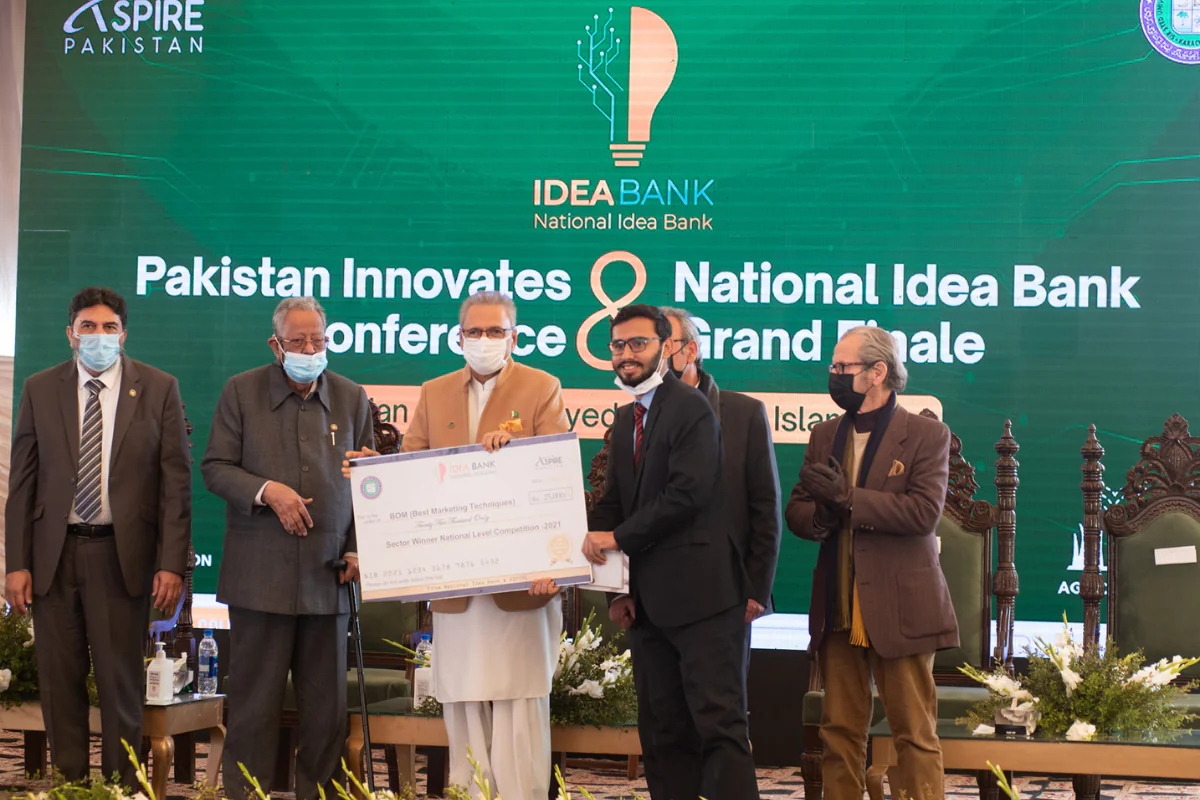
In the rapidly evolving landscape of Pakistani health-tech, few names resonate as strongly as Muhammad Ali Abbas. As a National Winner of the National Idea Bank (NIB) 2021, Abbas has transitioned from a visionary engineering student to the CEO of Haprow, a startup dedicated to empowering children with special needs through cutting-edge robotics.
His journey is not just a story of academic excellence, but a testament to how empathetic innovation can solve deep-rooted societal challenges.
National Idea Bank 2021
The National Idea Bank, an initiative inaugurated by the President of Pakistan, Dr. Arif Alvi, was designed to harvest the country’s best creative minds. In 2021, amidst thousands of entries, Muhammad Ali Abbas—a graduate of the Usman Institute of Technology (UIT)—clinched the First Position in the Healthcare Sector.
His winning idea addressed a critical gap in the Pakistani healthcare system: the lack of accessible, specialized therapy for children with Autism Spectrum Disorder (ASD). Recognizing that there are over one million children in Pakistan affected by autism, yet a severe shortage of trained therapists, Abbas proposed a robotic intervention.
Meet TimTim: The AI Companion
At the heart of Abbas’s success is TimTim (initially prototyped as PEEKO), a socially assistive robot designed to act as a bridge between a child’s isolated world and the social environment around them.
Key Features of TimTim
-
Bilingual Communication: The robot interacts in both Urdu and English, ensuring it is culturally and linguistically relevant for Pakistani families.
-
Emotion Recognition: Using advanced AI algorithms and cameras, TimTim can detect a child’s facial expressions and emotional cues, adapting its responses to keep the child engaged.
-
Safe Interaction: Equipped with ultrasonic and touch sensors, the robot navigates its environment safely, ensuring that its presence is non-threatening to children who may have sensory sensitivities.
-
Companion Therapy: Unlike traditional screens, the physical presence of a robot encourages eye contact, verbal response, and motor skill development.
From Concept to Startup: The Launch of Haprow
Winning the NIB was the catalyst Abbas needed to move from a prototype to a commercial entity. He founded Haprow, a robotics startup focused on “Technology with a Heart.”
Haprow has successfully moved through the MVP (Minimum Viable Product) stage and into the commercialization phase. By 2024, Haprow began deploying units in leading medical institutes and therapy centers in Karachi and Lahore.
Bridging the Cost Gap
One of Abbas’s primary missions is affordability. While international companion robots can cost upwards of $5,000 (approx. 1.4 million PKR), Haprow aims to provide TimTim at a price nearly 70% lower than global competitors. This makes advanced AI therapy accessible to the Pakistani middle class and local NGOs, rather than just elite private clinics.
Impact and Future Vision
The impact of Muhammad Ali Abbas’s work extends beyond the hardware. His research, which has been presented at various academic forums, shows that children interacting with TimTim exhibit:
-
Increased Attention Spans: Children who typically struggle to focus on humans often find the predictable, non-judgmental nature of a robot easier to engage with.
-
Reduced Parental Stress: By providing a “co-therapist” at home or in school, the robot alleviates the constant 24/7 pressure on caregivers.
-
Data-Driven Progress: Through a connected mobile app, parents and therapists can track the child’s interaction history and developmental milestones.
Global Ambitions
Muhammad Ali Abbas isn’t stopping at the borders of Pakistan. With recognition from the Google Cloud Startup Competition and interest from investors in the UAE and Saudi Arabia, Haprow is poised to become a global player in assistive robotics.
Abbas envisions a future where every special education center in the developing world has access to a TimTim robot, ensuring no child is left behind due to a lack of human resources.
Conclusion
Muhammad Ali Abbas represents the new face of Pakistani innovation—one that combines technical prowess with a deep sense of social responsibility. As the winner of the National Idea Bank 2021, he has proven that Pakistan can be a creator of technology, not just a consumer. Through Haprow, he is giving a voice to those who struggle to speak and a friend to those who feel alone.